Our purpose and values
Purpose
Vision
To safeguard public confidence in the integrity of Parliament and government institutions.
Mission
To help elected and appointed public officials avoid conflicts of interest.
Mandate
Administer the Conflict of Interest Code for Members of the House of Commons and the Conflict of Interest Act so as to manage conflicts of interest.
Values
Respect for people
We foster inclusion, civility and dignity in our interactions with colleagues and stakeholders.
Professionalism
We are diligent and consistent, while maintaining a spirit of collaboration that is strengthened by the diversity of people and ideas.
Integrity
We build and maintain trust by upholding the highest ethical standards and demonstrating responsible stewardship.
Impartiality
We provide independent, objective and non-partisan direction and advice, while remaining open to a diversity of views.
Building a roadmap for 2025-2030
This strategic plan serves as a formal roadmap, outlining long-term goals and the actions necessary to achieve them. It provides a clear framework to align our resources and efforts with our mission: to help elected and appointed public officials (“regulatees”) avoid conflicts of interest. By following this plan, we aim to transform challenges into opportunities and drive meaningful progress for the Office.
What do we want to achieve in the next five years?
The Office’s main objective is to provide clear guidance, education, and effective enforcement in a timely manner.
The process of complying with the Conflict of Interest Act and the Conflict of Interest Code for Members of the House of Commons must be modernized, simple and efficient. Specifically, the Office must provide tailored, proactive guidance to help regulatees navigate complex situations and remain in compliance during their time in office and while moving in and out of public office.
In the next five years, the Office must work towards the following three goals:
- Embrace innovation: The Office must adopt and leverage new technologies to enhance efficiency and productivity in its work. It must develop innovative tools and resources to improve awareness and compliance.
- Remain neutral: The Office must respond to evolving legislative and political contexts to stay relevant, safeguard its impartiality, and help the public understand and trust its role and effectiveness.
- Preserve expertise: In the next five years, there is anticipated turnover in the Office’s senior positions. The Office must retain corporate memory and invest in developing talent and expertise.
How will the strategic plan help to achieve these goals?
The Plan establishes four focus areas, enabling the Office to purposefully create and implement supporting projects and initiatives.
1 – Avoiding conflicts of interest
Enhance and streamline our processes, strategies, and resources to ensure that regulatees can efficiently and effectively manage their conflicts of interest, while supporting transparency and accountability.
2 – User-friendly experience
Ensure that every interaction—whether through the website, the portal or employees—provides a positive, seamless, and user-centred experience, fostering trust, understanding, and satisfaction for all regulatees.
3 – Healthy and fulfilling workplace
Foster a healthy, inclusive, and fulfilling work environment where employees consistently act with and embody integrity in their actions. Promote a workplace culture that supports diversity, hybrid work, and professional development.
4 – Tools, knowledge and skills
Provide employees with reliable, modern tools, and appropriate training to equip them with the knowledge and skills needed to effectively fulfill the Office’s mandate.
Objectives and expected results of each focus area
1 – Avoiding conflicts of interest
Enhance and streamline our processes, strategies, and resources to ensure that regulatees can efficiently and effectively manage their conflicts of interest, while supporting transparency and accountability.
Objectives
- Streamline compliance processes: Simplify initial compliance processes, annual review processes, disclosures, declarations and the set-up of compliance measures.
- Enhance transparency and accountability: Communicate clearly and accessibly about the regimes the Office administers.
- Provide clear and consistent advice: Ensure that all Office interactions offer aligned guidance.
- Tailor training and education: Offer customized training for regulatees during onboarding, throughout their term in office and after they leave office.
- Increase public engagement: Develop educational and parliamentary outreach programs to build understanding and clarify the Office’s role and mandate.
- Publish user-friendly products: Create accessible materials that explain investigation reports as well as changes to and interpretations of the Act and the Code, and manage them through efficient and streamlined processes.
- Ensure compliance: Help regulatees remain compliant during their mandate and as they move in and out of office.
Expected results
- Consistency and clarity: Demonstrate consistent application of the rules.
- Prevention focus: Centre compliance processes and education on preventing conflicts of interest.
- Election readiness: Be prepared to support regulatees throughout and after the election process.
We will measure our progress by comparing the results of the public office holder and Member surveys and internal file audits. The Office will keep track of processes that are streamlined, making note of the timeline to complete tasks, modifications, changes to delegation of authority to complete them, and the use and updates of the Internal Practice Manual.
2 – User-friendly experience
Ensure that every interaction—whether through the website, the portal or employees—provides a positive, seamless and user-centred experience, fostering trust, understanding, and satisfaction for all regulatees.
Objectives
- Offer a reliable portal: Provide fast and straightforward transactions.
- Maintain a user-friendly website: Ensure that information is easily accessible and user-focused.
- Promote transparency: Integrate a searchable public registry.
- Support positive user experiences: Ensure that regulatees have positive interactions with the Office.
Expected results
- Successful information submissions: Regulatees successfully submit comprehensive information with minimal technical issues and increasing self-sufficiency with subsequent use.
- Accessible information: Regulatees and the general public can find, and make use of, general information on the website.
- Prioritized needs: Advisory and compliance processes will prioritize the needs of regulatees.
We will measure our progress by comparing the results of the public office holder and Member surveys. The Office will track the status of the tools that were implemented (advisory and compliance portal, modernized and integrated website and public registry, etc.) and feedback from internal and external users.
3 – Healthy and fulfilling workplace
Foster a healthy, inclusive and fulfilling work environment where employees consistently act with and embody integrity in their actions. Promote a workplace culture that supports diversity, hybrid work, and professional development.
Objectives
- Engage and motivate the workforce: Foster an engaged and motivated workforce.
- Promote inclusivity and equity: Implement inclusive and equitable practices across the Office.
- Support bilingualism: Respect and support bilingualism.
- Minimize security risks: Strengthen measures to minimize security risks.
- Facilitate knowledge transfers: Establish processes for proactive knowledge transfers and structured onboarding.
- Ensure effective communications: Maintain timely and effective internal communications.
- Identify and mitigate stressors: Develop mechanisms to identify and mitigate common stressors such as workload, file complexity, deadlines, and service standards.
- Update and reinforce standards: Update and reinforce the Code of Values and Standards of Conduct.
Expected results
- Follow the Office’s Code of Values: Put the Code of Values into practice both inside and outside the Office.
- Achieve a successful hybrid workplace: The Office will maintain a successful hybrid workplace.
- Respond to workforce challenges: The Office will anticipate and mitigate workforce challenges.
We will measure our progress by comparing the results of employee satisfaction surveys, participation rates for professional development and retention levels. Human resources practices will include periodic reviews of hiring practices and workplace demographics. IT and Security will conduct audits, incident reporting and annual employee training to measure and ensure effectiveness and understanding of security requirements. Feedback through formal and informal channels will be used to understand internal communications, stress and workload, and learning and adoption success with Office tools, among other things. The Office will conduct pulse surveys as well.
4 – Tools, knowledge and skills
Provide employees with reliable, modern tools and appropriate training to equip them with the knowledge and skills needed to effectively fulfill the Office’s mandate.
Objectives
- Ensure a user-friendly client management system: Support Office employees with a user-friendly client management system.
- Prioritize coherent information management practices: Implement coherent information management practices that are designed for employees to follow with guidelines.
- Monitor and analyze trends: Track and analyze trends that may affect the work of the Office.
- Facilitate expertise sharing: Promote formal and purposeful sharing of expertise, including soft skills, within the Office and through active participation in external knowledge groups.
- Provide comprehensive training: Offer ongoing employee training on systems and tools.
- Standardize collaboration tools: Standardize the use of collaboration tools and publish an Office-approved list (OneNote, Loop, Teams chat, etc.).
- Enhance onboarding process: Streamline, formalize and enhance the onboarding process for new employees and managers.
- Encourage shadowing and collaboration: Promote employee shadowing, collaboration and mentoring.
Expected results
- Support the Office’s mandate: Ensure that all tools, systems and initiatives directly support the Office’s mandate and reduce purely administrative tasks required in compliance processes.
- Anticipate challenges: The Office will monitor and anticipate internal and external challenges.
- Provide formal training: Employees will receive formal rounds of training on new processes and tools.
We will track our progress and continually improve by monitoring key indicators. This includes analyzing results from employee satisfaction surveys, tracking the number of formal training sessions organized, and calculating the percentage of employees who complete both mandatory and optional training. Additionally, we will conduct adoption surveys or establish metrics to assess the use and effectiveness of the tools and processes provided to employees.
Monitoring progress and measuring results
Progress on the plan will be reported to the Senior Management Committee every quarter and shared with the Office on the intranet.
Projects and initiatives will be added to the leads’ performance agreements to ensure that their workload adequately reflects these new initiatives.
|
Focus area |
How will we measure success? |
|---|---|
|
Avoiding conflicts of interest The processes, strategies and resources that help elected and appointed public officials manage their conflicts of interest are efficient. |
Minimal number of references to the rules not being applied equally in the public office holder and Member surveys. Website analytics. |
|
User-friendly experience The user has a positive experience in each interaction with the Office (website, portal, advisor). |
Minimal number of references to the tools not being user-friendly in the public office holder and Member surveys. Website analytics. |
|
Healthy and fulfilling workplace The Office promotes a healthy, inclusive and fulfilling work environment where employees always act with integrity. |
Employee feedback is positive (employee satisfaction surveys, pulse surveys, minimal number of negative comments in the suggestion box). |
|
Tools, knowledge and skills Employees are equipped with reliable and modern tools, insights and skills to help fulfill the Office’s mandate. |
Thorough research is undertaken to leverage the benefits of artificial intelligence (AI) and other technologies, employees are trained on these tools and given guidance on their safe and effective use. Employee feedback is positive (employee satisfaction surveys, pulse surveys). |
Additional research
What challenges do we face?
Directors, managers and employees helped to identify internal challenges as well as challenges in the outside environment.
Pressing internal challenges
Workload
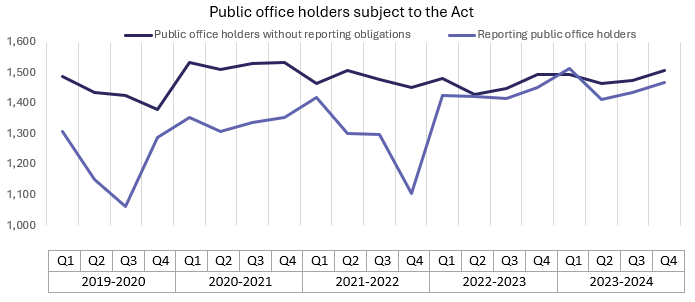
The increasing volume and complexity of requests for advice from regulatees, along with the rising number of reporting public office holders over the past five years, add significant complexity to compliance and enforcement.
Internal tools
Completion of and transition to a new client management system are necessary, in addition to planning for updates.
Information management
Improvements to information accessibility are needed, ensuring consistent corporate records, especially for elected and appointed public officials’ files.
Safety and security
Complete a Threat and Risk Assessment and update policies accordingly.
Website renewal
Office surveys with regulatees, as well as informal public feedback, demonstrate that the website is not providing the help needed and requires a structure that allows key audiences to navigate to the information they want. Envisioned updates include a more interactive and plain language search or chatbot feature to help guide users.
Adapting to hybrid workplace
Continue operating in a hybrid model while moving to a new floor, which requires transition planning.
Plain language
The Office is adapting most of its products to incorporate plain language. It will need to continue to develop its practices to ensure that plain language is being used adequately where necessary.
Employee expertise and tools
In recent years, case files and requests for advice have become more complex, especially when regulatees have multiple controlled assets and holdings. The Office must ensure that advisors have the tools necessary to manage these complex files effectively. The Office needs to develop internal processes and systems that make information easier to find, analyze and digest, while maintaining robust security protocols.
The Office must identify the expertise necessary to integrate AI and generative AI tools responsibly. These technologies offer opportunities across the Office, but they must be integrated in ways that support innovation and collaboration without hindering progress, while being mindful of risks of bias and overreliance. It is important to properly train employees on these tools and provide guidance on their safe and effective use.
Challenges identified during the 2024 public office holder survey and the 2024 Members survey
- A small number of respondents indicated that there were inconsistencies in the advice provided and level of experience among advisors.
- There is an opportunity to improve procedural guidance related to certain matters.
- There is a perception that the Office tends to focus on small administrative issues, not on the big issues that affect trust in government.
- There is growing interest in in-person meetings.
- There is an opportunity to use more plain language in products.
- The Office’s current disclosure forms are not seen as user-friendly.
Political challenges
Changing political landscape
Changes to the political landscape directly affect the Office’s workload. General elections lead to turnover, may shift the parliamentary dynamics, typically mean increased movement from the public sector to the private sector, and result in changes to Governor-in-Council (GIC) appointments. The composition of Members of Parliament changes (younger, more tech-savvy, interested in hybrid work, etc.), and this is also reflected in GIC appointments in some areas.
Erosion of trust in Parliament
Trust in Canadian institutions and Parliament has declined (Transparency International’s Corruption Perception Index, 2025 Edelman Trust Barometer, Organisation for Economic Co-operation and Development (OECD) survey, etc.). Scandals related to conflicts of interest and ethics breaches receive media and public scrutiny. These scandals were discussed at length by parliamentary committees. The Commissioner was invited on numerous occasions to appear before committees to discuss these issues and provide a better understanding of the role of the Office.
Values and ethics are a salient topic
Integrity in public institutions is a strong prevention tool for corruption. The Treasury Board Secretariat and the Privy Council Office are looking to update their values and ethics tools. Ethics commissioners across Canada have published investigation reports that have received national attention. The Office must be prepared to apply new advances internally.
Open government
There is a push towards increased transparency from government. The Office must monitor and advance its open government policies, ensuring that they do not conflict with confidentiality rules related to regulatees.
Economic challenges
Increased scrutiny on public spending and procurement
Recent procurement processes and funding decisions have received intense media and public scrutiny. Public spending has become a common topic during question period and in the media. This rising scrutiny related to government expenses may translate into greater oversight of the Office’s budget and expenditures. This may require creative solutions to reduce budget spending. Questions about finding efficiencies among various organizations through administrative mergers may be raised during parliamentary appearances. Legislative changes could further alter jurisdictions, and increase workloads and the complexity of functions.
Inflation and federal deficit
Affordability and the federal deficit are top of mind for Canadians and for regulatees. Programming choices related to budget reductions have been discussed and are being implemented in the core public administration. The Office will need to adapt to this new environment.
Shared economy and cryptocurrencies
The ever-shifting economic landscape affects the definitions of assets in the Act and the Code.
Social challenges
Adapting to a hybrid workplace
In 2025, the Office will move to a new, modernized workspace reflective of a planned hybrid workplace. This will require adjustments in employee engagement, collaboration, and productivity management, coupled with updated policies and practices to ensure a smooth transition.
Office turnover and demographics
Office demographics are shifting (turnover shift of 4% in the past five years, 23% of employees and managers will meet retirement eligibility in the next five years, new generation is joining the workforce).
Implementing ethics in the workplace
There is an emphasis on creating a strong integrity structure within public institutions. (The Treasury Board, OECD, Council on Governmental Ethics Laws and Réseau francophone d'éthique et de déontologie parlementaires are focusing on ways to measure and enhance public integrity.) The Office must determine which new practices it should apply to maintain a solid framework for integrity.
Respecting bilingualism
The Office is acquiring a number of new tools and technologies. While employees must be able to work in the official language of their choice, the Office must also deliver its services in the language of choice of regulatees and other interested parties.
Prioritizing accessibility, diversity and inclusion
The federal government and Parliament are continuing to advance accessible and inclusive procedures and policies. The Office’s statistics for employment equity designated groups are in line with the representation within the federal public service (women (77%), members of a visible minority (18%), persons with a disability (18%), Indigenous people (5%)).
Technological challenges
Automation and artificial intelligence
The Treasury Board Secretariat is further developing policies and directives on automated decision making and the use of AI. This is a field that will likely reshape current policies and procedures. This is an opportunity for the Office to automate certain processes (workflow automation, transcription and drafting tools, summarizing tools, media monitoring).
Security threats and cyberattacks
New cybersecurity challenges that result in security breaches require the Office to be well equipped to handle these new threats. The Office must also increase its expertise on the numerous ways that AI can be used to access confidential information.
Misinformation and disinformation
The rise of disinformation increases the need to be the source for credible information related to the role and functions of the Office. The Office must also increase its expertise on the numerous ways that AI can be used to share false information.
Legal challenges
Conflicts of interest on the spectrum of corruption
Preventing conflicts of interest is strongly linked to the prevention of corruption. This link is widely discussed by international counterparts. Although the Canadian legal system separates the two, the Office can still gather best practices related to the fight against corruption.
Foreign interference legislation
New legislation on foreign interference may have an impact on the Office’s work by introducing enhanced scrutiny or additional requirements for appointed public officials, as well as potential changes to the Office’s scope of responsibilities.
Five-year trends
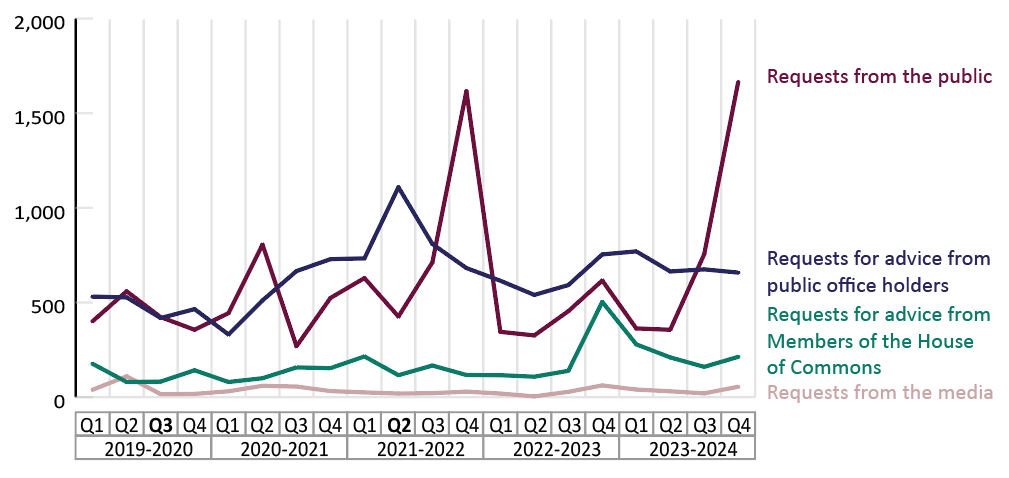
Bolded quarters indicate that a general election took place (October 2019 and September 2021)
Bolded quarters indicate that a general election took place (October 2019 and September 2021)
Preliminary implementation plan
A preliminary list of projects and initiatives has been identified by focus area to ensure progress towards the strategic plan’s objectives. For each initiative, a designated lead will be assigned, along with a clear timeline and a budget to establish accountability.
A more detailed implementation plan will be developed collaboratively with each lead to outline specific steps and success measures. Progress will be reported quarterly, providing transparency and an opportunity to assess outcomes. The plan will also be refreshed annually to enable informed discussions on timelines, scope, adjustments, shifts in direction, or the removal of initiatives that no longer align with the Office’s priorities or goals. This process ensures continuous alignment, accountability and adaptability.
|
Focus area |
Project/Activity/Initiative |
|---|---|
|
Avoiding conflicts of interest |
Tailored formats for training and development for Members and public office holders |
|
Avoiding conflicts of interest |
Expanded training and education focus to ensure that regulatees understand the rules and address all conflicts of interest |
|
User-friendly experience |
Creating an Office-wide process to implement changes to interpretation of the Act/Code. Understanding the impacts of interpretation changes and adapting implementation. |
|
User-friendly experience |
Improving transparency and adherence to “open governance” |
|
User-friendly experience |
Streamlined compliance processes: minimum clicks and manual work for users |
|
User-friendly experience |
A user-friendly website that allows the user to find information quickly |
|
User-friendly experience |
A new functional client management tool and portal that requires minimal time and effort from the user. The tool should also provide a robust information management structure to help streamline compliance processes. |
|
User-friendly experience |
Digital training tools are made available to the Office’s key audiences |
|
Healthy and fulfilling workplace |
Updating internal human resources policies |
|
Healthy and fulfilling workplace |
Staffing continuity plan for the Office |
|
Healthy and fulfilling workplace |
Preparing for the retirement of key management employees |
|
Healthy and fulfilling workplace |
Threat and risk analysis is conducted |
|
Healthy and fulfilling workplace |
Equity, diversity and inclusion are prioritized |
|
Healthy and fulfilling workplace |
Accessibility Plan is implemented |
|
Tools, knowledge and skills |
Harnessing collaboration tools for the hybrid world |
|
Tools, knowledge and skills |
Data analytics and monitoring are improved and shared across the Office |
|
Tools, knowledge and skills |
Improving information management practices |
|
Tools, knowledge and skills |
Surveys of Members and public office holders are conducted approximately every two years, and the results are used to monitor progress |
|
Tools, knowledge and skills |
Formal and specialized training and development opportunities are identified for the Office |
|
Tools, knowledge and skills |
Research into past Members’ questions about lobbying and conflict of interest regimes being merged |